
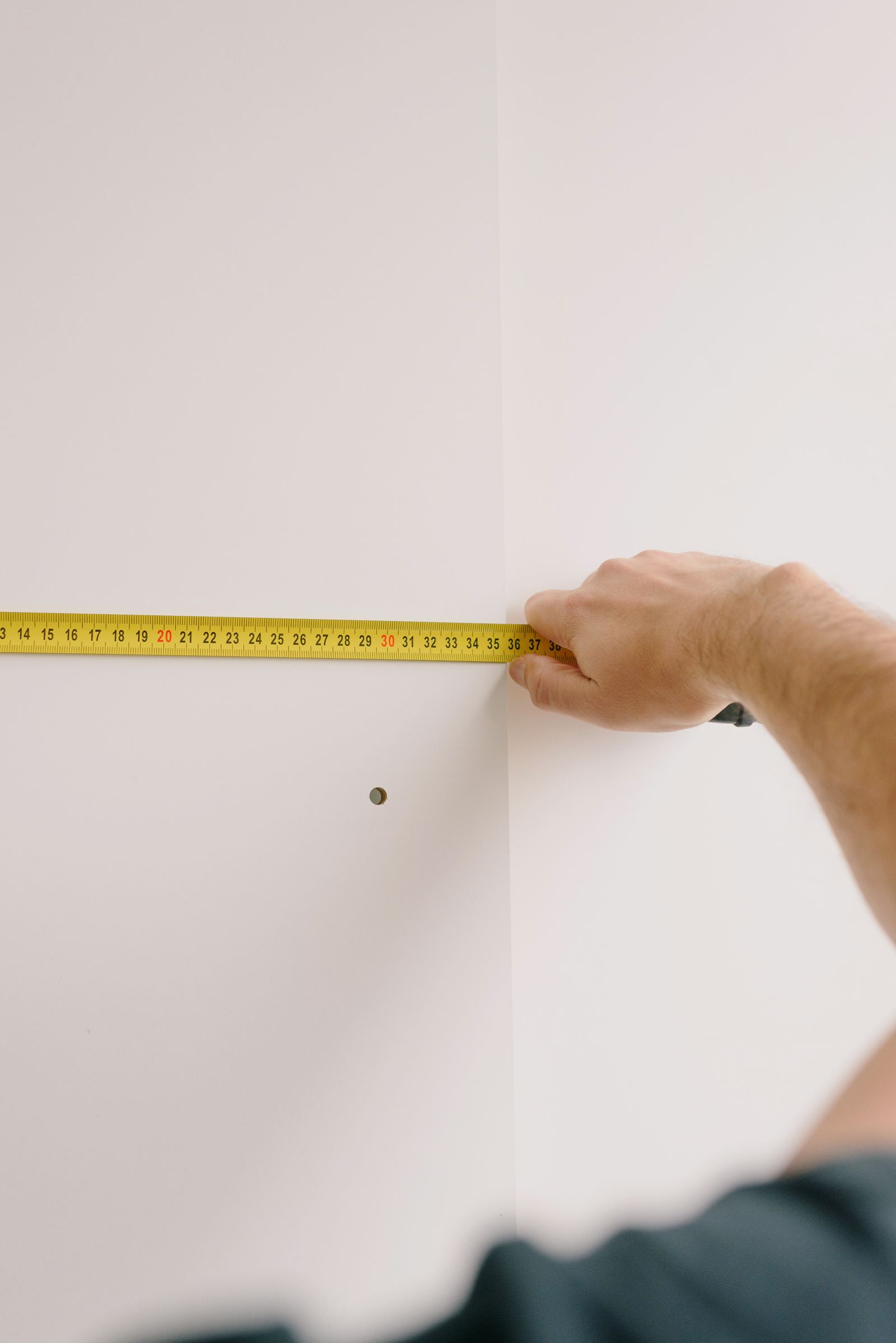
How High Should You Hang Pictures? (With Chart)
This post contains affiliate links. If you buy through them we may earn a small commission at no extra cost to you. Read our full disclosure.
Nobody notices a picture that is hung correctly. Everybody notices one that is hung too high — the frame floating up near the ceiling, disconnected from the sofa underneath it, like it is trying to escape the room.
There is a standard answer, and then there is the answer for your actual room. This guide gives you both: the single number to use when you are in a hurry, a room-by-room chart for when you are not, and the measuring method that gets it right the first time.
The rule in one line
Hang art so the center of the piece sits 57 inches (145 cm) above the floor.
That is the museum and gallery convention, sometimes called the “57-inch rule,” and it exists for a good reason: 57 inches is roughly average human eye level. When a room’s art is all centered on that line, any group of pieces feels deliberate, even if you mixed sizes, frames and mediums.
Why 57 inches is not always the answer
The 57-inch rule assumes you are standing and looking at a bare wall. Three things override it:
- Furniture. Art hung over a sofa or a bed is anchored to the furniture, not to the floor. If the piece connects to the sofa, the eye reads them as one unit.
- Ceiling height. In a room with 12-foot ceilings, 57 inches can look stranded. Tall rooms usually want art higher, even without furniture under it.
- Where you view it from. Dining rooms and offices are often viewed while seated, which pulls the comfortable band lower.
The rule is a default, not a law. Use it when nothing else is telling you what to do, and let the chart below take over when something is.
Hanging height chart: the numbers by situation
Measure the bottom edge of the frame unless the row says “center.” All figures are inches above the floor.
| Situation | Bottom edge | Center | Note |
|---|---|---|---|
| Bare wall, no furniture (default) | — | 57–60″ | The museum standard. Start here. |
| Above a sofa | 8–10″ above the sofa back | 57–60″ | The most common mistake is hanging too high. Keep the gap to one hand span. |
| Above a bed / headboard | 8–10″ above the headboard | 57–60″ | Widen the piece or pair to about two-thirds the bed width. |
| Above a console or entry table | 6–8″ above the tabletop | 57–60″ | Keep the art narrower than the console so both read as one group. |
| Above a desk (home office) | 8–12″ above the desk | — | You view this seated, so a lower center feels right. |
| Dining room, over a sideboard | 8–10″ above the sideboard | 57–60″ | For art hung on the wall rather than over the table. |
| Hallway or narrow wall | — | 57–60″ | Line every frame up on the same center line; it reads as a single run. |
| Stairwell (following the slope) | 6–8″ above the handrail | — | Measure perpendicular to the rail, not to the floor. |
| Bathroom, over a vanity | 6–8″ above the backsplash | — | Smaller pieces; leave clearance for the mirror. |
| Gallery wall (whole arrangement) | — | 57–60″ | Center the group, not each frame. See spacing below. |
| Very tall room (10 ft+ ceilings) | — | 60–66″ | Nudge the band up so the art does not look lost. |
| Low furniture, tall wall (e.g. a low dresser) | Keep the gap to 6–8″ | — | Anchoring to the furniture beats anchoring to the floor here. |
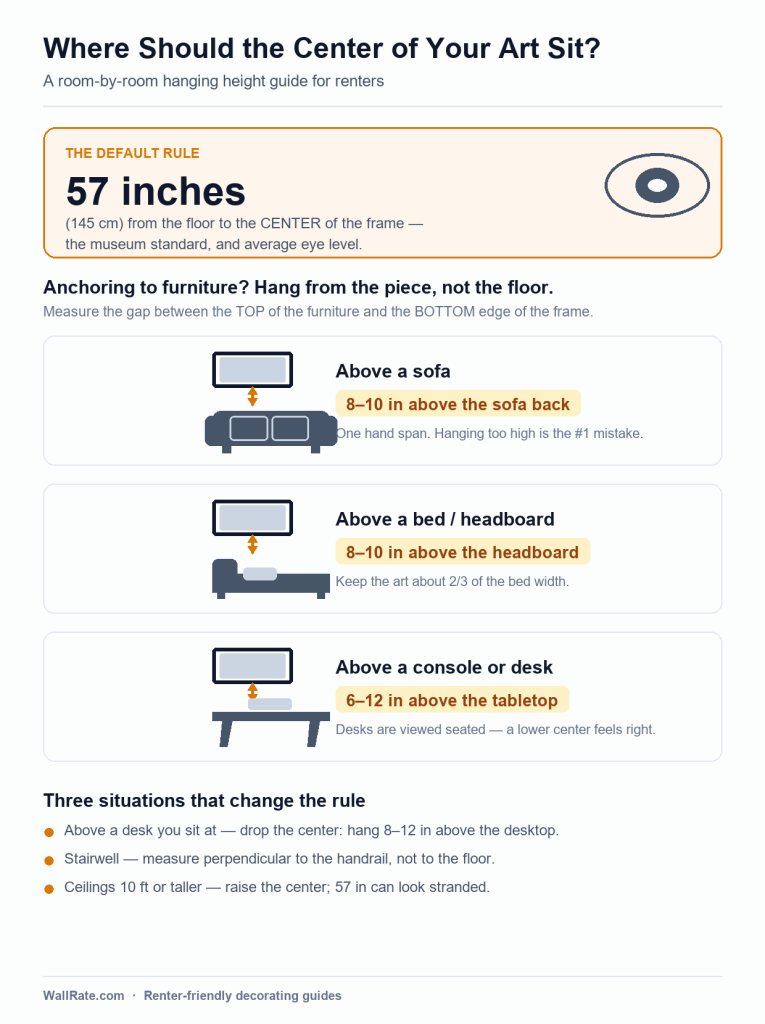
Visual reference: where 57 inches lands
| 78 in | Near the ceiling in an 8 ft room — only for very tall rooms and very large art |
| 60–66 in | High band — use with 10 ft+ ceilings, or to clear tall headboards |
| 57–60 in | Standard center-of-art band. Your default. Works with most furniture in most rooms. |
| 52–56 in | Seated-view band — dining rooms, desks, and art above low furniture |
| 44–50 in | Too low for most walls; correct only over very low furniture like a bench |
Read that band once and you will stop second-guessing yourself. If a piece looks off and its center is not in the 57–60 inch band, that is almost always the reason.
Above furniture: the gap is the whole trick
When art sits above furniture, the viewer’s eye groups the two objects. That means the gap between them decides everything.
- Sofa: 8–10 inches between the top of the sofa back and the bottom of the frame. Any more and the art floats; any less and it crowds the people sitting there.
- Bed: 8–10 inches above the headboard. A single wide piece or two matched pieces, together about two-thirds of the bed’s width, fill the space without dominating it.
- Console table: 6–8 inches. Entry areas are viewed standing and often in motion, so a slightly tighter gap keeps the group reading as one.
- Desk: 8–12 inches. Anything under 8 inches will get hit by a monitor or a lamp.
A useful sanity check: make the art slightly narrower than the furniture beneath it. If the art is wider than the sofa, the sofa looks like an afterthought.
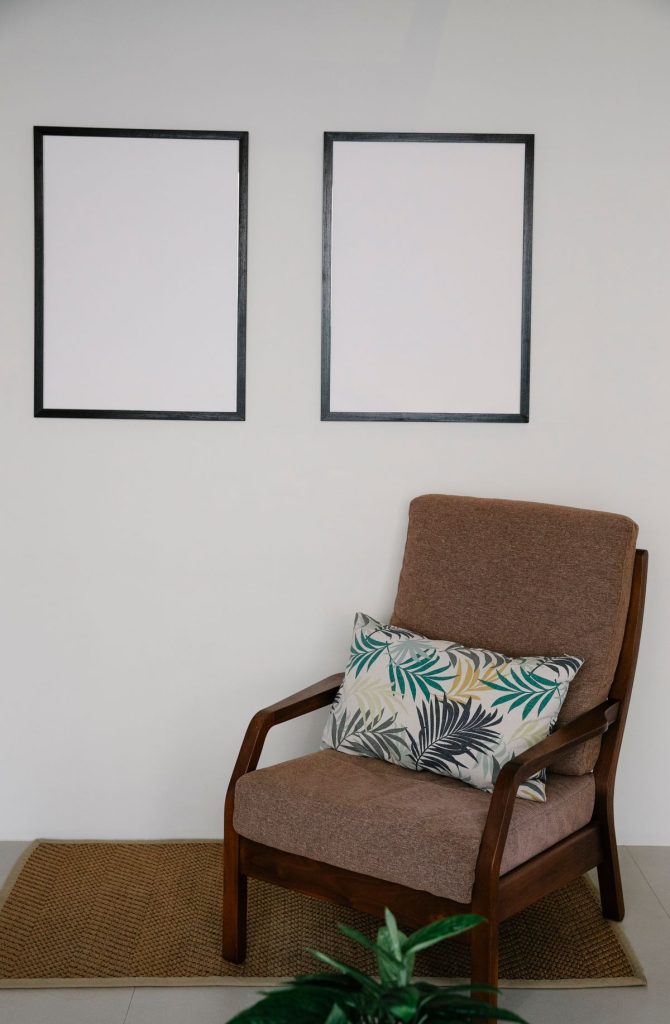
Hanging more than one piece
Groups are where most people go wrong, because they measure each frame from the floor instead of measuring the arrangement.
- Center the group on 57–60 inches. Place the middle of the whole arrangement — not each individual frame — on that line.
- Space frames 2–4 inches apart. Two inches for small frames, three to four for large ones. Consistent spacing matters more than the exact number you pick.
- Line up at least one edge. Align all tops, or all centers, or lay out in a clean grid. Random arrangements only look intentional when the spacing is perfect, and it rarely is.
- Lay the layout on the floor first. Trace the frames onto paper, tape the paper to the wall, and live with it for a day before you commit.
- Use one anchor line for a hallway run. Every frame centered on the same height reads as a deliberate collection even if the frames differ.
How to measure it: six steps
- Decide the target for the bottom edge. Take the number from the chart, or use 57 inches minus half the frame height for a bare wall.
- Measure the frame’s own hanging geometry. Turn the frame over. Measure from the top edge down to the highest point of the wire when pulled taut, or to the top of the D-ring or sawtooth. Write it down — this is the number people forget.
- Add the two numbers. Hook height above the floor = target bottom edge + frame height − hanging offset.
- Mark the wall lightly with a pencil where the hook will go. Mark the center line too, so the frame is horizontally centered on the furniture or wall.
- Check level. For two hooks, place them the same distance apart as the frame’s hardware. A level is not optional here.
- Hang, then stand back and look from the doorway. If it feels slightly high, it is high. Your eye is more reliable than the tape measure at this stage.
A worked example
A 24-inch-tall frame with a wire whose highest point sits 3 inches below the top edge, going above a sofa with a 32-inch back:
- Target bottom edge = 32 in (sofa back) + 9 in (gap) = 41 in from the floor.
- Hook height = 41 + 24 − 3 = 62 in from the floor.
That single calculation is the difference between “looks professional” and “why does that look wrong.”
Tools that make this a five-minute job
- A tape measure — obvious, and still the tool people skip.
- A small level — a 9-inch torpedo level is enough for one frame; a 24-inch level earns its place for gallery walls.
- A laser level or a self-adhesive layout template — the fastest way to keep a group aligned.
- Picture hanging hardware matched to your wall — and if you are renting, see our guide to hanging pictures without nails.
Laser levels for hanging art on Amazon →
Picture hanging kits on Amazon →
Seven mistakes that make good art look wrong
- Hanging too high. The classic. If you are unsure, you are almost certainly at the wrong end.
- Measuring from the frame top instead of the hook. The offset is different for every frame — always measure it.
- Ignoring the furniture. A 57-inch center over a very low sofa is technically correct and looks terrible.
- Art wider than the furniture below it. Breaks the visual grouping.
- Uneven spacing in a group. Pick 2, 3 or 4 inches and use it everywhere.
- Forgetting the viewing position. Standing rooms and seated rooms want different heights.
- Skipping the level on the second hook. A single hook can be eyeballed. Two hooks cannot.
Frequently asked questions
Is 57 inches measured to the center or the bottom of the frame?
To the center. The rule is about where the viewer’s eye lands, so the middle of the artwork goes on the 57-inch line. If you have a low sofa and want the bottom edge to sit 9 inches above it, use the furniture gap instead.
What if my frames are all different sizes?
Center each frame on the same line (57–60 inches) rather than aligning tops or bottoms. Center alignment is the most forgiving arrangement and it is what museums use.
How high should art hang above a bed?
8–10 inches above the headboard as a starting point, with the group centered around 57–60 inches. If you have a very tall headboard, follow the headboard rather than the floor.
How high should I hang art in a hallway?
Center it at 57–60 inches and keep every frame on that same line. A hallway is a standing-view space, so the standard rule applies cleanly.
Should I hang art over the dining table?
Most designers hang art on the wall near the table rather than directly over it. If you do hang over the table, keep the bottom edge about 8–12 inches above the tabletop so nobody stands up into it.
What about a staircase wall?
Follow the slope of the stairs: measure perpendicular to the handrail and keep the art 6–8 inches above it. Center everything on an imaginary line parallel to the stairs, not a level line.
The takeaway
Default to 57–60 inches on center. Break the rule for furniture, tall ceilings and seated rooms, using the chart above. And always measure your frame’s hanging offset before you make a mark — it is the one number that turns a guess into a measurement.
Decorating a rental without damaging it? Start with our guide to removable peel and stick wallpaper for renters, or go straight to the nail-free options in how to hang pictures without nails.
2 Comments